
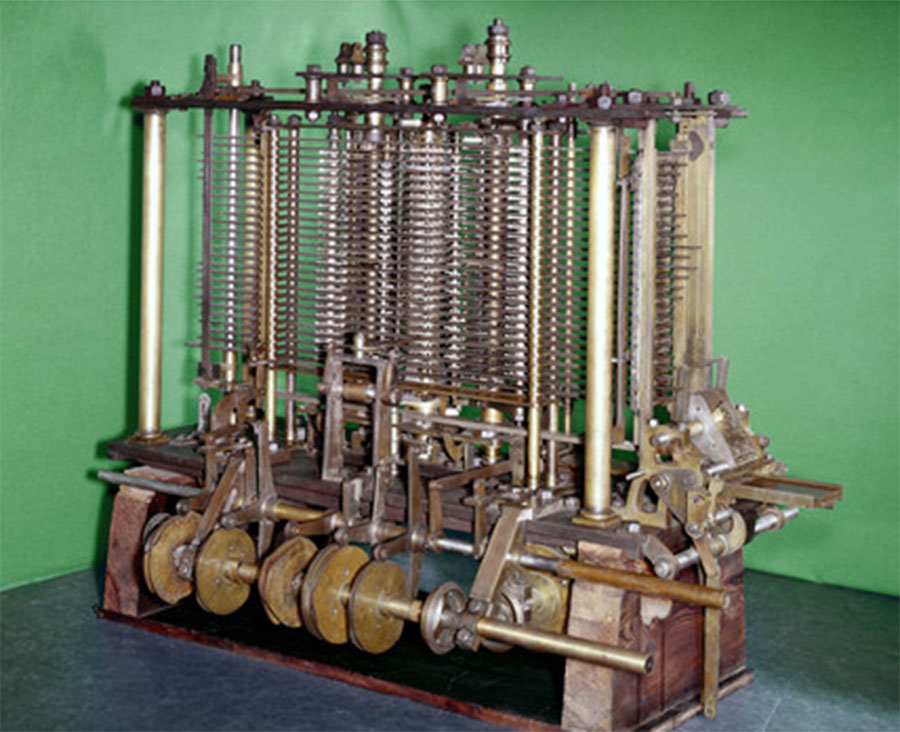
November 1834 - The Analytical Engine
In November 1834, at a dinner party at Mary Somerville’s “Ada heard … Babbage’s ideas for a new calculating engine, the Analytical Engine. He conjectured: what if a calculating engine could not only foresee but could act on that foresight. Ada was touched by the ‘universality of his ideas’” (Toole).
In Babbage’s time, mathematical tables, such as logarithmic and trigonometric functions, were generated by teams of mathematicians working day and night on primitive calculators. Since these people performed computations, they were referred to as “computers.” (Simon and Maxfield)
In 1812 Babbage stated, “I wish to God these calculations had been performed by steam.”
The Analytical Engine was a “more sophisticated machine called an Analytical Engine. The Analytical Engine was intended to use loops of Jacquard’s punched cards to control an automatic calculator, which could make decisions based on the results of previous computations. This machine was also intended to employ several features subsequently used in modern computers, including sequential control, branching, and looping. (Simone and Maxfield)
“Babbage worked on plans for this new engine and reported on the developments at a seminar in Turin, Italy in the autumn of 1841” (Toole). If Babbage had ever finished the machine, Ada’s program “would have been able to compute a mathematical sequence known as Bernoulli numbers” (Simon and Maxfield).

