
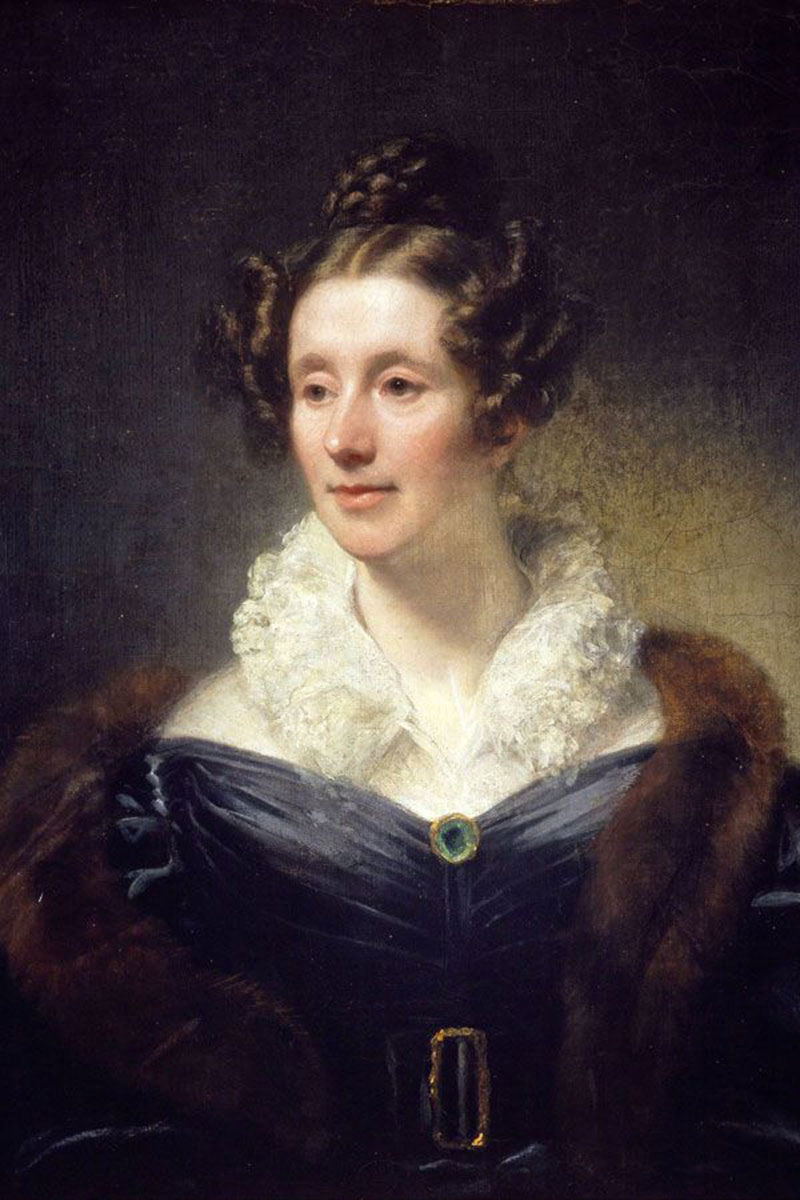
1833 - Ada and “Scientist” Mary Somerville
On this same trip to London, when Ada met Charles Babbage, Ada met Mary Somerville, the woman for whom the word ‘Scientist’ was made” (Kelly). Before Mary the term used was “man of science,” but Mary changed that.
“In 1834, when scientific historian William Whewell read Somerville’s treatise, On the Connexion of the Physical Sciences, he wanted to write a review. Since Mary could not be called a ‘man of science’ her changed the word to scientist. He coined the term to ‘reflect the interdisciplinary nature of Somerville’s expertise.’ She was not just a mathematician, astronomer, or physicist; she possessed the intellectual acumen to weave these concepts together seamlessly” (Kelly).
Mary Somerville encouraged Ada to continue her studies and suggested she read Euclid’s Elements of Geometry. After Ada left London, she corresponded regularly with Somerville and Babbage about Mathematics. Somerville must have been a great influence on Lovelace.
For the rest of her life, Mary Somerville continued updating her treatise, and “in the third edition … Somerville wrote that difficulties in calculating Uranus’s position may indicate the existence of an undiscovered planet. This led to the discovery of Neptune” (Kelly).

